What’s in our Camera Bag? A Travel Photography Gear Guide

Are you planning to travel and looking for a new travel camera? Look inside our camera bag to learn more about our tech gear. We are self-taught travel photographers. In 2008, we started with a disposable underwater camera. This quickly changed after our first trip, when we upgraded to an Olympus Tough camera, which we slowly upgraded and added additional gear to over the years.
Disclosure: This post contains some affiliate links or referral links for your convenience. It is a way for this site to earn advertising commissions by advertising or linking to specific products and/or services. Click here to read our full disclosure policy.
Why Did We Choose This Setup For Our Travel?
One of our most important considerations when traveling and carrying camera tech gear is keeping it as lightweight as possible without sacrificing flexibility and capabilities.
We wanted to be able to carry all the tech gear we needed in one backpack. So we have opted to carry one lens for our main camera and only pack the necessities, keeping the backpack lightweight without sacrificing the ability to capture whatever the world throws at us. We also recognize that keeping all our gear in a single bag can be a security issue, so we purchased a bag that also met our security needs.

Our Travel Cameras & Lenses
Over the years, we (Megan) have expanded and upgraded our camera travel bag. This is what our current bag looks like while we are traveling. Remember, we didn’t start with all of this gear and have acquired it over our years of travel, so we will provide budget-friendly travel photography gear recommendations at the bottom of this post.
Sony A7S III – Our Main Camera
Our main camera body is the Sony A7S III. This camera delivers incredible quality in both photography and videography. It is a mirrorless camera, meaning its body is lighter than a DSLR. We have also upgraded to a full camera cage with a handle. The cage adds more protection to the camera, plus allows you to mount more things to it. Where the cage handle makes it easier to video closer to the ground and carry the camera.
Tip: Don’t forget to buy an extra Sony battery.
UPADTED: Tamron 28-200mm 2.8-5.6 Lens
The Tamron 28-200 F/2.8-5.6 is our new all-around lens. We got this lens because it’s lightweight and has a great zoom length. This lens is always on the camera!!! We only change it when we are in places with limited space.
Tip: Don’t forget to buy a variable ND filter for your lens.
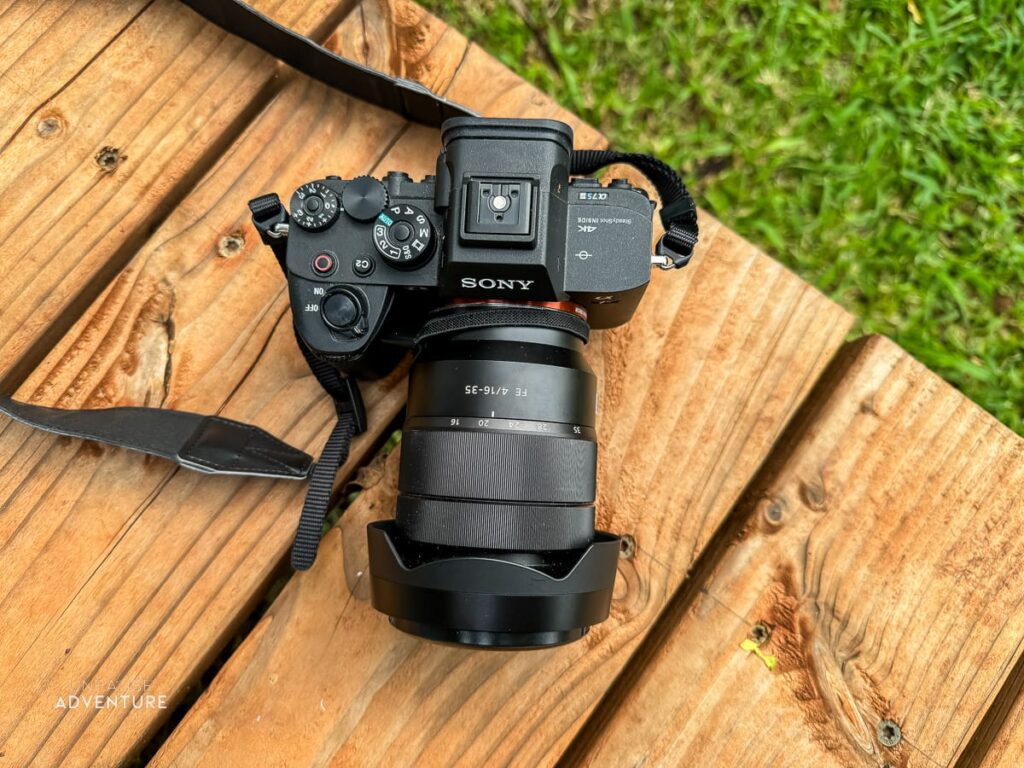
Sony 16-35mm Lens
The Sony Vario-Tessar 16-35mm f/4 lens is a great wide-angle 16-35mm lens that is great for landscape photos and photos with limited space (Megan purchased it for this reason). We also purchased this lens because it doesn’t cost a fortune.
Point and Shoot Camera – iPhone
Sometimes, you’re not prepared or don’t have time to get your camera. Our phones are our quick point-and-shoot camera option because if you’re like us, you won’t want to miss the shot. And if you have an updated phone, you can take beautiful pictures and videos. Megan currently uses the iPhone 15 Pro, and Eric uses the iPhone 17 Pro. Both take great 4k videos and photos.
Our Waterproof Cameras
These cameras are our go-to for active outdoor adventures, whether you’re snorkeling, scuba diving, or just out for a hike.
GoPro Hero 11
The GoPro Hero 11 is our go-to waterproof camera for videoing underwater while traveling. This is the camera we use while snorkeling and scuba diving. A floating hand grip and spare batteries (plus a quick charger) are must-have accessories. But we also recommend getting the protective housing that allows you to go scuba diving.
TIP: When scuba diving, light changes with depth, so you need to add a red filter to a camera. We use the Backscatter Flip Stick 2 Filter.
Dome Port
We wanted the option to film above and below the water at the same time when snorkeling. So the Shoot Dome Port is fantastic for this, and it also lets you be more stable with your footage thanks to the two handles.
Our Drone
A drone gives an entirely new perspective of a location. Unfortunately, it is getting harder to fly a drone without a permit or finding areas without restrictions so choosing the right drone is becoming increasingly important. Despite some of the challenges we never regret having it with us on our travels!
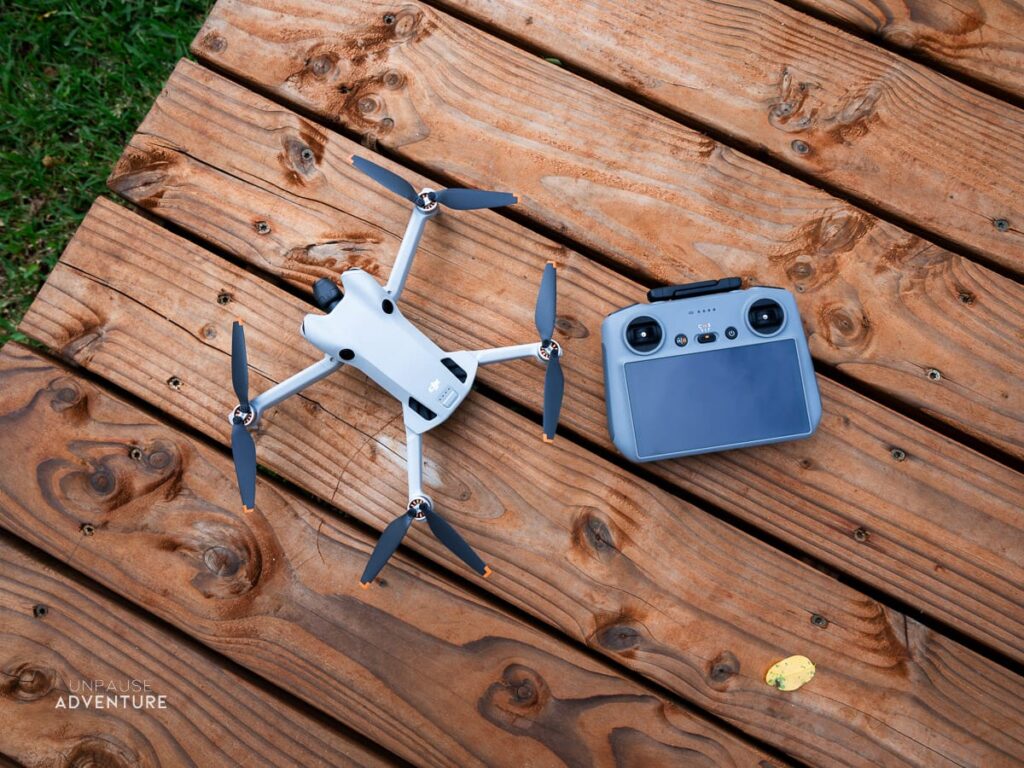
DJI Mini 4 Pro
We have opted to carry the DJI Mini 4 Pro over the bigger models because many locations will not require a permit or have you register the drone if it’s under 250g (we sold our DJI Mavic Air for this reason). We love the quality of the videos this compact model captures. A spare battery is a must-have accessory. That’s why we recommend buying the kit that comes with extra batteries. We also recommend using variable ND filters on your drone, too.
Travel Photography Accessories
Travel photography accessories fill up the other half of our camera bag. Most of these items are to enhance photos and videos, but all are recommended.
Travel Camera Backpack
With all the tech gear we needed to carry around, we decided we needed a bag that could not only hold all of the gear but also be lightweight and secure. The Wandrd PRVKE 31L with the Photography Bundle (cube insert) holds the drone, lens, camera, laptop + charger, tripod, camera accessories, and a water bottle, and there is still room at the top.

Filters
Every camera lens should have a filter. A filter protects the surface of the lens against dust, moisture, and the occasional thumbprint. The primary function of lens filter is to improve the image quality of your pictures.
TIP: Make sure you purchase the right filter for your lens size.
Basic Len Filter
The Basic UV Haze Filter is a fantastic alternative to a standard lens filter. It protects and improves the quality of your videos and photos.
Variable Neutral Density Filter
The ND (Neutral Density) filters stop light from reaching the sensor. This is extremely useful when traveling and shooting in bright daylight. We use the Tiffen Variable ND Filter to ensure our footage is not washed out.
Memory Cards
We always carry our waterproof SD card case, which includes four SanDisk 256GB Extreme PRO SD cards and four SanDisk 512GB Extreme Micro SD cards. Both card types are high-performance, so they are capable of quickly saving 4K video footage. Micro SD cards are used for the drone and GoPro. We never want to run out of memory space!
Cleaning Kit
An air blower and a cleaning kit are essential in keeping our camera’s sensor and lens clean so they are ready for use.
Travel Tripod
A tripod is handy when you need a steady shot, and we have debated taking one with us. We use the GorillaPod.
Tech Cord Organizer
With all the tech gear needed to document traveling, many cords and other random tech equipment need a place to call home. We use a Tech Bag Organizer to store everything.
Editing Gear
After capturing all the footage, the photos and videos must be sorted, backed up, and edited. Here’s the gear we use for editing our travel content.
Laptops
Our MacBook Air with the M2 chip (Megan’s) and MacBook Air with the M3 chip (Eric’s) are where we work on blog content, edit photos and videos, and so many other things. The M2 & M3 chip allowed us to downsize from the Macbook Pro and still be able to edit videos without any issues.
TIP: Don’t forget adapters to export your footage and back up your footage. We use the Apple USB-C to SD Card Reader and the Apple USB-C to USB Adapter.
SSD External Drive
We use two Samsung T7 Shield 4TB Portable SSD external hard drives to back up our photos and videos while traveling. Believe us, you don’t want to lose any footage. An SSD is small and extremely fast; the only downside is the higher price, but it is worth the extra cost.
Lightroom
Editing all our photos is done in Adobe Lightroom. Using our custom presets and the Sync function allows us to edit our photos quickly.
DaVinci Resolve
To edit videos, we use DaVinci Resolve because it’s a one-time purchase and has great features that make your videos pop.